Receiving a Certificate of Appreciation for CivicPulse from the Rotary Club of Mountain View.
CivicPulse is a platform where Los Altos residents can report local infrastructure problems, upvote what matters most to them, and track whether anything gets resolved. Residents drop a pin, attach a photo, and submit a report in under a minute. The app has a live map of all active reports, community upvoting so the most urgent issues surface first, push notifications, and an admin dashboard for city staff. It was covered by the Los Altos Town Crier in April 2026 and is in active use with LAMVCF and the Rotary Club. The iOS app is live on the App Store.
Hypervolume and Pareto-front size against molecules evaluated, MOGP compared with four baselines.
Drug discovery for neglected tropical diseases is underfunded and computationally expensive. Screening a billion compounds on a single processor core would take 475 years. Caleb and I are building a surrogate modeling pipeline that uses a Multi-Output Gaussian Process trained on molecular fingerprints to predict ADMET properties, meaning Absorption, Distribution, Metabolism, Excretion, and Toxicity, from a molecule's SMILES string alone. Rather than collapsing drug-likeness into a single score, the model treats human safety, absorption, and synthesizability as conflicting objectives on a Pareto front, and uses Expected Hypervolume Improvement to choose the next molecule to evaluate. The goal is to let underfunded NTD researchers skip expensive wet lab screening and go straight to a ranked list of promising candidates. We are validating the approach by simulating rediscovery of a known drug at a fraction of the documented cost and time.
Every notice becomes a countdown, colored by how little time is left.The on-device model's rewrite, labeled as machine written with the original letter kept below.
During the 2023-24 Medicaid unwinding, more than 25 million people lost coverage, and among states reporting a reason, KFF's tracker counts 69% of those disenrollments as procedural, meaning paperwork rather than a finding of ineligibility. They were already enrolled, so I am building Carta for retention rather than enrollment. A recipient photographs the renewal letter, a CalFresh SAR 7 or a Medi-Cal redetermination, and the app reads it on the phone, finds the deadline buried inside, and schedules reminders against it. Nothing on that path touches the network, enforced by a test that disables fetch, XMLHttpRequest, WebSocket, and the native bridge, verifies the sabotage really throws, then replays 79 recorded scans and fails on any attempt. A deterministic extraction cascade reaches 96.4% precision on core fields and 100% on every date the app schedules against, measured across 23 photographs shot in nine physical conditions rather than on clean synthetic text. An optional on-device Qwen2.5-1.5B model rewrites a notice in plain language at 1.3 seconds to first token and 37 tokens per second on an iPhone, held to a hand-written GBNF grammar, and it withholds any explanation citing a date the user has not confirmed. It runs in English and Spanish, though that rewrite still answers Spanish letters in English and is unfinished. Getting a model onto the phone at all meant a 4-bit quantization of Qwen2.5-1.5B down to about 1.1 GB, shipped as an optional download rather than bundled into the app, plus the iOS entitlements that let a process hold that much in memory. The grammar is the third design rather than the first. Constraining the shape of a date let through 00/00/0001, and a grammar with no production meaning "not stated" left the sampler no legal way to abstain, so on a notice with no deadline the model confidently emitted the notice date instead.
React Native, Expo, TypeScript, Apple Vision OCR, llama.rn, Qwen2.5-1.5B, Jest, iOS
ResidualMap
Conrad Challenge 2026-27, Water Challenge. Tested in simulation, real-utility pilot next.
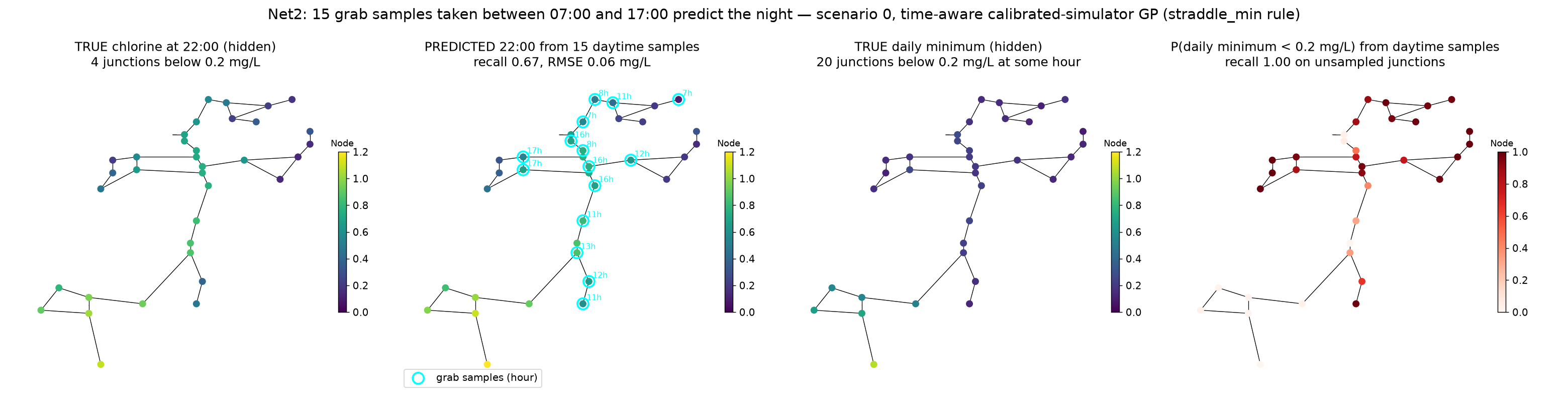
Fifteen daytime grab samples predicting the night. The right-hand map caught every unsampled junction whose chlorine dropped below the safe minimum. Click to enlarge.
About 81% of American community water systems serve fewer than 3,300 people, and most of them have no sensors or live data, just a handful of chlorine grab samples a month taken during working hours. That leaves a blind spot. Chlorine decays the longer water sits in the pipes, so it runs lowest at night and at dead ends, exactly where and when nobody samples. In one simulated network, 40% of junctions were below the 0.2 mg/L safety minimum at midnight, while averaging the daytime samples flagged none. ResidualMap combines those grab samples with the EPANET pipe model the utility already has. It runs the town's own model 675 times with different guesses for how fast chlorine decays in that water and those pipes, weights each run by how well it explains the real samples, then uses a Gaussian process to correct what the simulations still get wrong. The result is a chlorine map of every junction at every hour with an honest 90% error band, the chance each one dips below 0.2 mg/L, and next month's sampling route. In simulation, three daytime samples find 94% of the junctions whose daily low falls below the minimum and eight find 99%, and the result held when the true network had a tank half the size the model assumed and a pipe closed that the model thought was open. It runs on a laptop with no sensors or internet connection. Every result so far comes from simulation, and a pilot with a real utility is the next step.
Working with a team led by current Google DeepMind executives. Aug 2026, ongoing.
Frontier models have effectively consumed the open internet as training data, and yet they still fall short on the tasks worth the most in our economy, the ones that need deep expertise, long term thinking, or taste. Closing that gap takes human judgement and verifiable outcomes, which is why benchmarks, arenas, and RL environments have grown into a multi billion dollar industry of their own. My work is a survey of that landscape. I am cataloguing which evaluation efforts exist, what model capability each one actually tests, how it collects human or verifiable judgements, and how it found an audience, including the ten or so that were built and never caught on. I map them along dimensions like domain, task complexity, and accessibility, meaning whether only a well funded lab can evaluate on it or whether an ordinary person can contribute. The point of the survey is to find a capability that is measurably weak, prove it with data rather than assert it, and then build the evaluation and training data that would improve it.
Benchmarks, arenas, RL environments, evaluation design, literature review
STEM Research Club
Founded and run at LAHS. Since 10th grade, ongoing.
I run workshops at LAHS for students who want to do research and have no idea what the first step is. The barrier is not interest, it is that nobody teaches you how to identify what you want to study, how to read an academic paper, or what a cold email to a professor should say. The workshops cover exactly that, plus literature review and resume preparation, and more than 100 people have come through them. We also bring in guest speakers, so far all of them working in AI, including venture capital partners and people at large tech companies, each walking through the path they took. The eventual goal is to connect members with professors and research programs at nearby community colleges and state universities.
Workshops, guest lectures, paper reading, cold outreach, literature review, resume preparation
Working through practice problems with students, the in-person program Kangaroo Atlas is built to serve.
Past papers tell a student the score, not which skill failed. I run a Math Kangaroo prep program for about 60 students a year. Most of that work is in person at the schools, sitting at a table with a group of kids and working a problem through out loud, and that room is where the program actually lives. We fix the problem a student missed, and the misconception underneath it survives to the next paper. Kangaroo Atlas is what I built instead. Every one of the 600 wrong answer choices stores the specific misconception that produces it, a rule the build enforces, so a score becomes a diagnosis rather than a number. Behind it sits a prerequisite graph over 91 named skills in 7 strands joined by 106 edges, so a miss on the adaptive diagnostic walks down to the skill underneath. I wrote all 150 problems myself, so no official Math Kangaroo question is ever reproduced, and each one carries a three step hint ladder and, where it needs one, a hand-drawn figure from a set of 25. Every one is hand written rather than generated or adapted, and each took a long sitting to analyze, because a problem is only worth including once it tests the skill it claims to test instead of rewarding a trick the student happens to have seen. Timed 75 minute mocks, per skill ladders, and printable worksheets whose answer key carries those explanations all run signed out, with no ads or trackers. It builds to 869 static pages behind 2,138 tests and 102 accessibility assertions, every one of them build-blocking. The goal is a free version of my program that another tutor can self host.
Blocked on Paper: measuring how online consent gets lost
Independent research, 2026, ongoing. Main measurement complete, paper in preparation for peer review. The paper, code, and tool will be linked here after the companies involved have been notified.
The gap this study measures, simplified. A cookie banner can block scripts on the page, but not the advertising pixels Shopify runs inside its sandbox.
When a website asks about cookies and you click Decline, you would expect it to stop tracking you. This project checks whether it actually does. Many online stores show a cookie pop-up that promises to block advertising code until you agree. But stores built on Shopify now run much of that code in a walled-off part of the page that the pop-up cannot reach. So a store can list an ad company as blocked while that company's code keeps sending data about your visit anyway. I built a program that visited 1,362 popular Shopify stores three ways, doing nothing, clicking only Decline, and with the browser's privacy signal on, and traced every message sent to an ad company back to the code that sent it. Shopify's own privacy switch mostly works. Consent gets lost in the handoffs around it: ad code that starts before you have chosen, and code that keeps running after you say no. Results will be published once the companies involved have had 45 days to respond. I also turned the program into ConsentCheck, a free tool that lets store owners check their own store.
You cannot fabricate a chip in a garage, so I explain chip design out loud instead. Voltage Drop covers what is happening at the frontier of electrical engineering and computation: new ways to build a chip, new ways to move data between chips, and the hardware underneath the AI systems most people only meet at the software layer. Each episode is a roughly ten minute breakdown of one idea, built from the primary sources, the original paper and the vendor's own published specifications, rather than from other people's summaries, and it names the actual hardware. Episodes so far have covered living neurons grown on silicon and trained to play Doom, and photonic interconnect replacing copper in AI data centers.
I'm a junior at Los Altos High School in Los Altos, CA. I tend to notice when something is not working, and I keep going until I understand why. That is roughly how CivicPulse started.
I kept walking past cracked sidewalks and broken streetlights around my neighborhood that nobody seemed to fix. It turned out there was no simple way for residents to flag those problems to the city, so I built one.
Right now I am a research intern at Paper Lantern, working with a team led by current Google DeepMind executives on how frontier AI models get evaluated. I spend my time mapping the landscape of benchmarks, arenas, and RL environments, figuring out what each one actually measures and why a handful of them became standards while most were built and then forgotten.
Outside of software, I mentor about 60 students a year in Math Kangaroo prep, compete on the VEX and FRC robotics teams, debate parliamentary for the speech and debate team, and run the STEM Research Club I started at LAHS. I make a podcast about chip design, and I have 200+ volunteer hours across the library, FCSN, and STEM outreach.
Highlights
A running record of the things I have competed in, built, led, or shown up for. The projects on the front page go into more depth.
Research
Research intern at Paper Lantern, working with a team led by current Google DeepMind executives on how frontier AI models are evaluated.
The work is a survey of that landscape, cataloguing what each benchmark, arena, and RL environment actually measures, how it collects human or verifiable judgement, and why a handful became standards while most were built and then forgotten.
Independent research on how online consent gets lost, measuring cookie banners against sandboxed advertising code across 1,362 stores. Paper in preparation for peer review.
Co-authoring a multi-output Gaussian process surrogate model for neglected tropical disease drug discovery, meant to let an underfunded lab skip a round of wet lab screening.
Math
4th place nationally in Math Kangaroo in 10th grade, and a multi-time national award winner.
Runs a Math Kangaroo prep program in its fifth year, teaching about 60 students a year, mostly in person at the schools. More than 30 have gone on to win national awards.
Built Kangaroo Atlas, the free and open source platform behind the program, around 150 hand written problems and a prerequisite graph over 91 named skills.
AMC 10 competitor.
Working through Math Kangaroo practice problems with students.
Robotics
VEX Robotics co-captain. Implemented inertial sensor integration so the autonomous routine held its heading instead of drifting off course.
FRC team member covering assembly, machining, and electrical work, and designed a spindexer, the rotating carousel that lines game pieces up one at a time.
Completed MIT Beaver Works "Basics of ASICs", covering digital logic and HDL chip design.
iOS app live on the App Store. Android submitted for review.
Active collaborations with LAMVCF and the Rotary Club, who gave CivicPulse a Certificate of Appreciation.
Building Carta, an on-device iPhone app that reads a government benefits letter and makes sure the deadline buried inside it is not missed.
Building ResidualMap for the Conrad Challenge, which maps chlorine across a small town's water pipes from the few samples its operators already take.
Speech and Debate
Parliamentary debater and state qualifier, ranked in the top 100 teams in the country.
PR and social chair. Plans and advertises events across multiple schools, reaching 200+ students a year, and works on funding and the record of past results.
Community
Founded and runs the STEM Research Club at LAHS, which has taught 100+ students how to find a research interest, read an academic paper, and write a cold email to a professor.
200+ volunteer hours across the library, FCSN, and STEM outreach.
100 of those at the Los Altos Library, organizing and pulling books and running the sorting machine.
JV tennis league champions as team captain.
Skills
Each with the project it was used on.
Building and shipping apps
Full-stack mobile app development, shipped to the App Store (CivicPulse)
Cross-platform iOS and Android with React Native and Expo (CivicPulse, Carta)
Web development with Next.js and static site generation, deployed on Cloudflare (Kangaroo Atlas, this site)
Accessibility and internationalization, WCAG 2.1 AA and English with Spanish (Kangaroo Atlas, Carta)
On-device machine learning
Local LLM inference on iOS with quantized GGUF models (Carta)
On-device OCR and structured field extraction (Carta)
Grammar-constrained decoding to block hallucinated fields (Carta)
Hardware benchmarking of latency and throughput (Carta)
Surrogate modeling and Bayesian optimization
Multi-output Gaussian process surrogate models (MOGP, ResidualMap)
Multi-objective Bayesian optimization with Pareto fronts and expected hypervolume improvement (MOGP)
Cheminformatics: molecular fingerprints, ADMET prediction, and docking validation (MOGP)
Calibrating a physics simulator against sparse field measurements (ResidualMap)
Benchmarking against baselines across seeds with held-out evaluation (MOGP)
Research and measurement
AI evaluation research across benchmarks, arenas, and RL environments (Paper Lantern)
Evaluation corpus design with real-world inputs and held-out sets (Carta)
Large-scale web measurement, tracing each network request back to the code that sent it (Blocked on Paper)
Survey statistics: cluster-bootstrap confidence intervals, paired tests, and inter-rater agreement (Blocked on Paper)
Precision and recall reporting with minimum sample thresholds (Carta)
Multi-seed experiments with confidence intervals (MOGP, ResidualMap)